
By Matthew Travers, President, Lead to Conversion · Original research collected October 13, 2026 · 100 practices in 20 U.S. metros
Direct Answer
Concierge practice marketing works best when a practice is easy to find in local search, shows what membership costs, and lets a prospective member join without a phone call. In our audit of 100 concierge and direct primary care (DPC) practice websites across 20 U.S. metros, only 6% of concierge sites let visitors enroll online and 33% published a price [1].
TL;DR
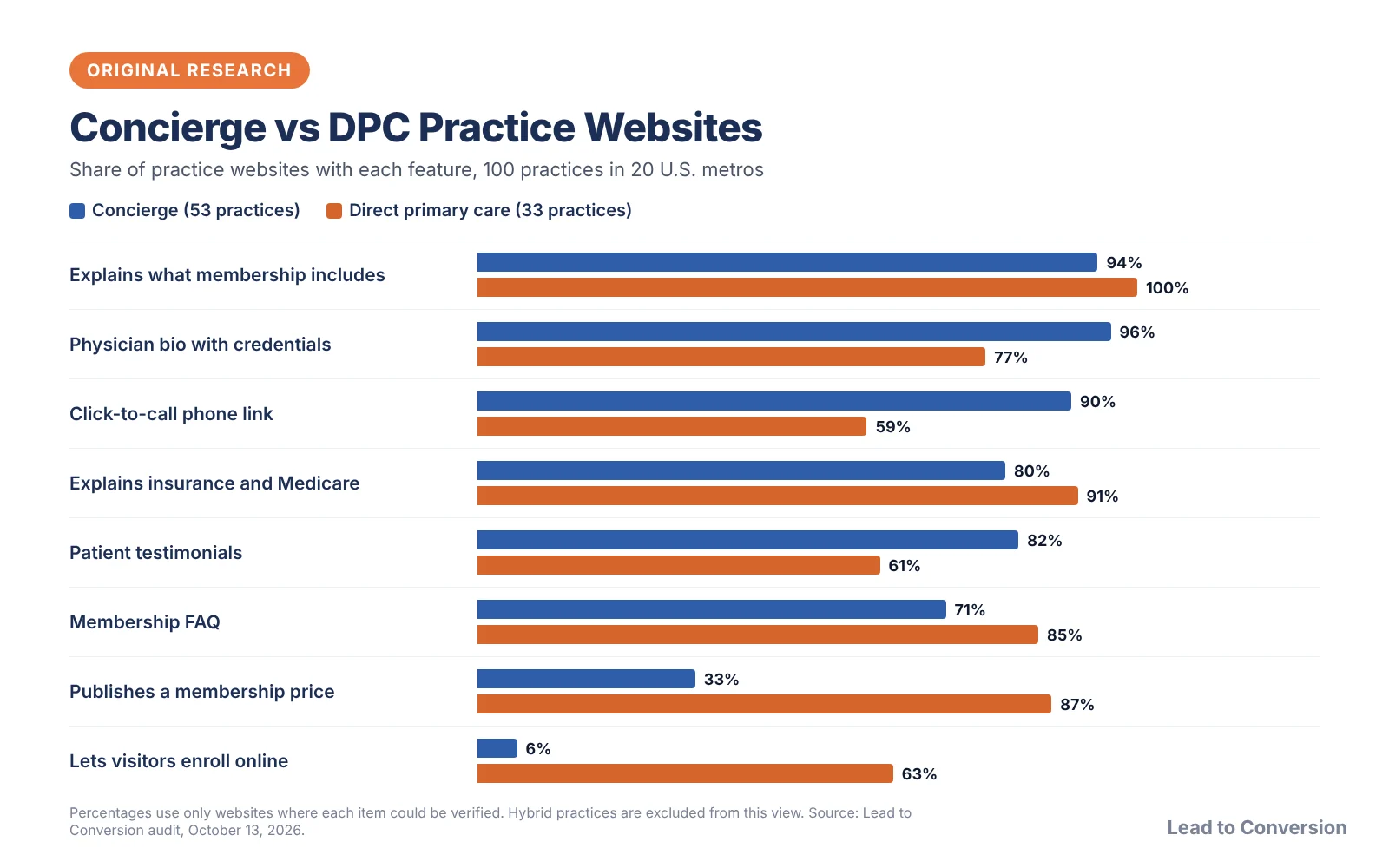
- Only 3 of 50 concierge websites (6%) let a visitor start enrollment online, compared with 19 of 30 DPC websites (63%) [1].
- 17 of 51 concierge websites (33%) publish a membership fee. Among DPC websites, 27 of 31 (87%) do [1].
- Concierge “Join” buttons send visitors to a general contact form on 30 of 53 sites [1].
- Nationally, “near me” searches for concierge and DPC care reach 9,200 a month, more than the 5,400 combined searches naming any of our 20 metros [2].
- Google answers “concierge doctor near me” with an AI Overview and a map pack before the first organic link [3].
- Just 7 of 79 fully verified websites include all eight membership-page basics [1].
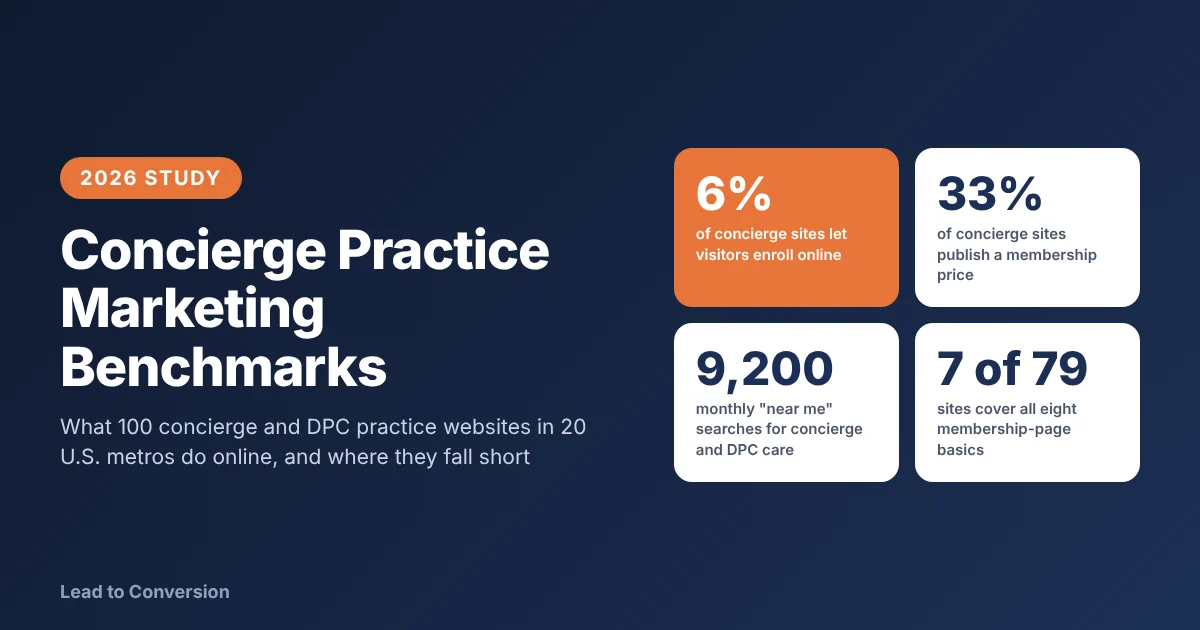
Most published advice on concierge practice marketing offers the same checklist: build a brand, post on social media, ask for referrals. Very little of it shows what practices actually do online.
So we measured it. On October 13, 2026, our team reviewed 100 independent concierge and DPC practice websites, five in each of 20 U.S. metros, and paired the results with search demand data for every market.
The seven strategies below each start from a number in that data.
Hybrid practices bill insurance and offer a membership add-on. See the full methodology for how practices were selected and checked.
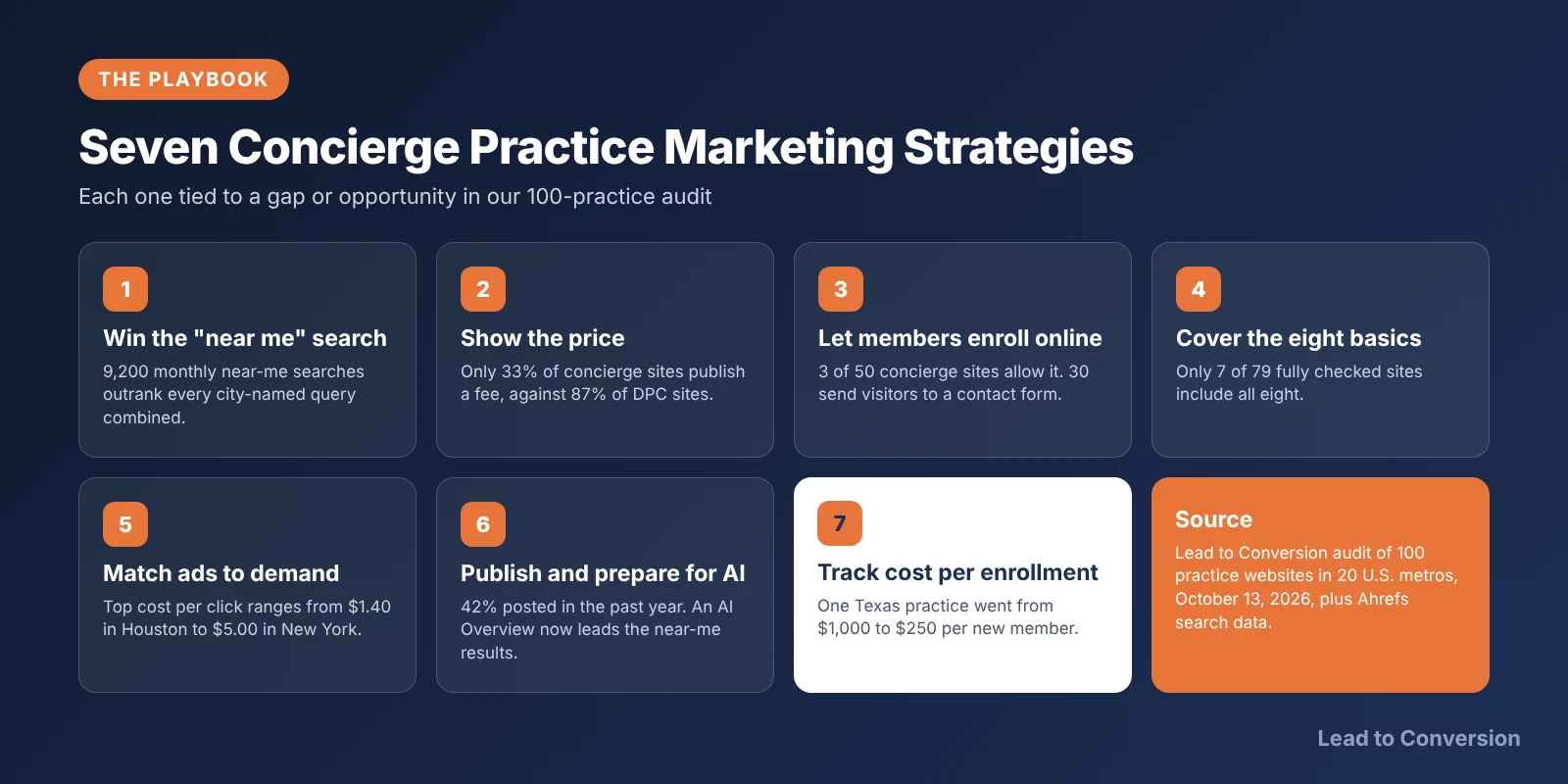
Strategy 1 · Local SEO
Win the “Near Me” Search With Local SEO
In short: patients search for concierge care close to home, and Google answers those searches with local results before any website link.
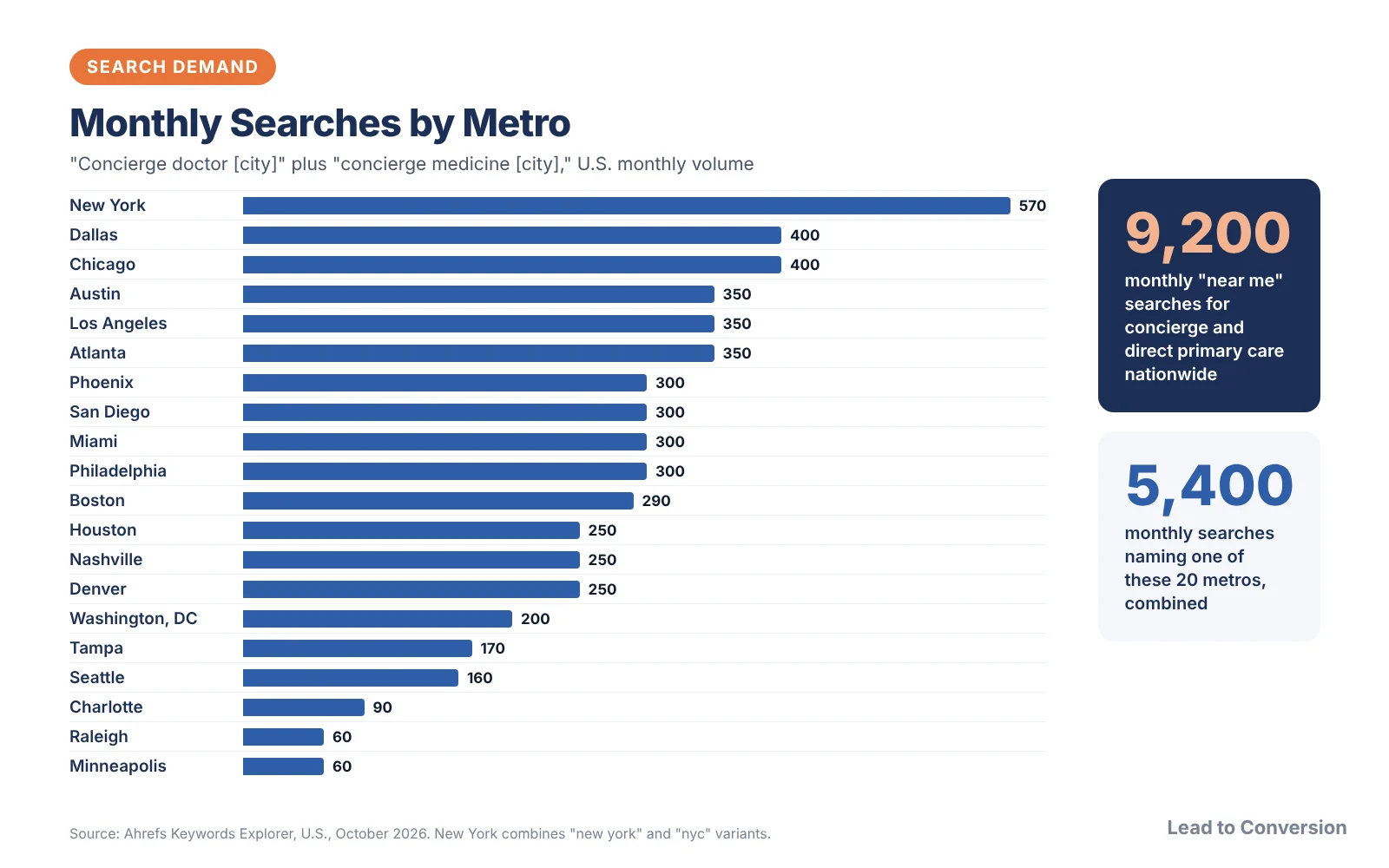
“Concierge doctor near me” draws 5,600 U.S. searches a month. Add “concierge medicine near me” at 1,900 and “direct primary care near me” at 1,700, and near-me demand reaches 9,200 searches a month [2].
Searches that name a city are smaller. Across all 20 metros in our study, city-named concierge searches add up to 5,400 a month, led by New York at 570 [2].
The results page shows where those searches land. For “concierge doctor near me,” Google opens with an AI Overview, then a three-practice map pack, then the first organic result [3].
Google ranks local results on relevance, distance and popularity [4]. Distance is fixed by your address. Relevance and popularity come from your Business Profile, your website and your reviews.
What to do:
- ✓Pick the most accurate primary category on your Google Business Profile and list every membership service.
- ✓Build a page for each area you serve, with directions, parking and access details.
- ✓Keep your name, address and phone number identical across directories and health listings.
- ✓Ask every member for a review the same way, with no incentives.
Strategy 2 · Pricing
Show the Price, or Explain What Sets It
In short: two out of three concierge websites keep the membership fee off the site, while most DPC practices publish theirs.
17 of 51 concierge websites in our audit list a membership fee. DPC practices publish at a far higher rate: 27 of 31 [1].
A prospective member who can’t find a fee has to call to learn it. The practice down the road that lists one gets compared first.
Three ways to handle it:
- ✓Publish each tier with its exact fee and what it includes.
- ✓List a “starting at” fee and the factors that raise it, such as age or family size.
- ✓Keep fees private, and say why on the membership page so the inquiry form reads as a next step, not a gate.
Strategy 3 · Enrollment
Let Prospective Members Enroll Online
In short: 63% of DPC websites let visitors join online. Among concierge websites, the figure is 6%.
We followed each site’s main Join or Enroll button. On concierge websites, 30 of 53 lead to a general contact form, 10 to a consultation booking and 6 to a phone number. Three start enrollment online [1].
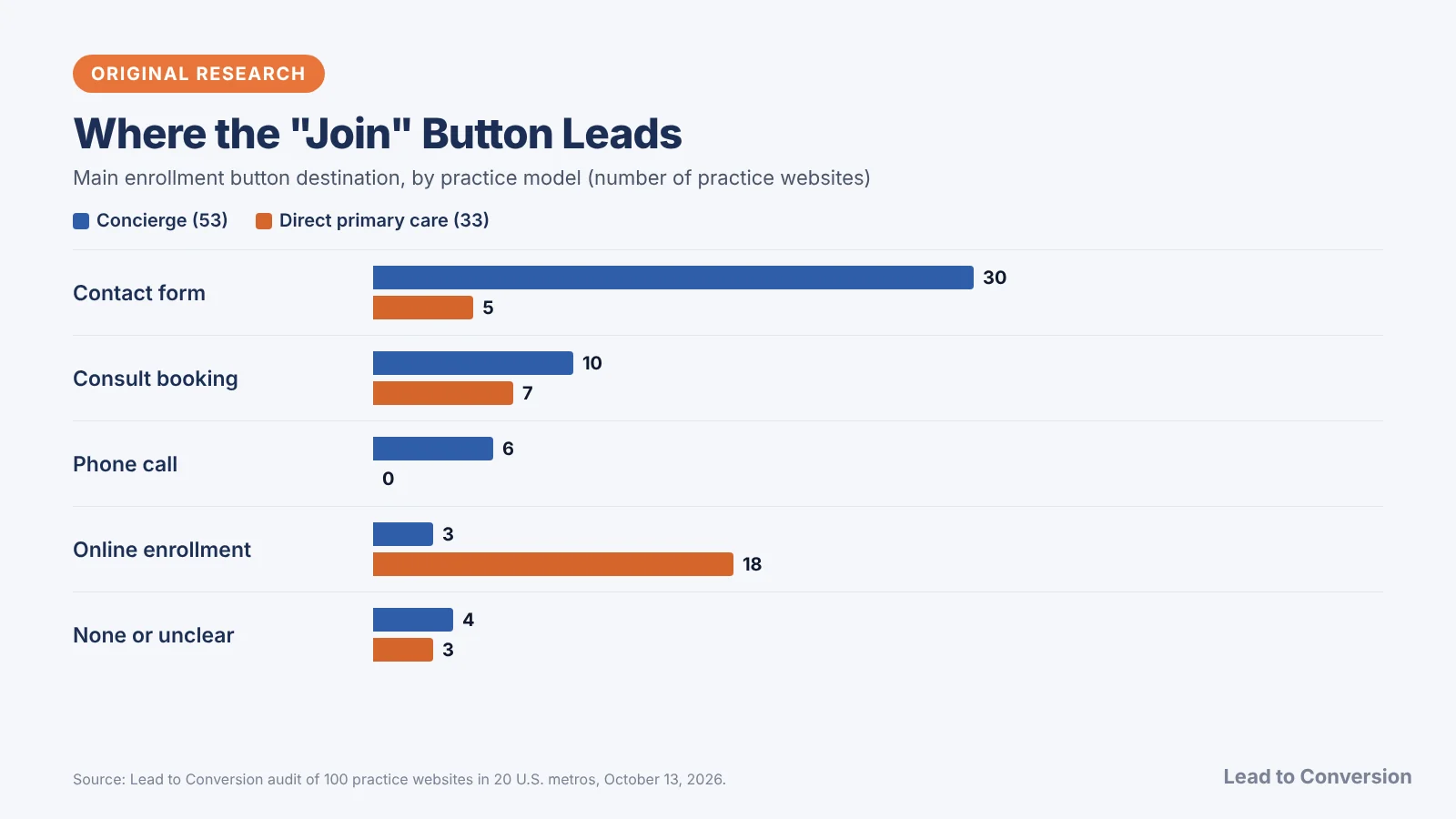
DPC practices built enrollment into the site itself. 18 of 33 DPC Join buttons start online enrollment, through membership platforms such as Hint, Atlas.md and SigmaMD [1].
A concierge practice can keep its meet-and-greet and still offer this. Give the page two paths: “Start enrollment” for visitors ready to commit, and “Schedule a call” for those who want to talk first.
Strategy 4 · Website Basics
Cover the Eight Basics on Every Membership Page
In short: practices explain their model well. Only 7 of 79 fully verified sites include all eight items a prospective member looks for.
| Item on the website | All practices | Concierge | DPC |
|---|---|---|---|
| Explains what membership includes | 97% | 94% | 100% |
| Physician bio with credentials | 90% | 96% | 77% |
| Explains insurance and Medicare | 81% | 80% | 91% |
| Click-to-call phone link | 80% | 90% | 59% |
| Membership FAQ | 75% | 71% | 85% |
| Patient testimonials | 73% | 82% | 61% |
| Publishes a membership price | 55% | 33% | 87% |
| Lets visitors enroll online | 26% | 6% | 63% |
Share of websites where each item could be verified [1]. Hybrid practices are included in “All practices.”
The first six items appear on most sites, so they set the minimum. The last two are where a practice pulls ahead: 29 of 79 fully verified sites scored six of eight, and 17 scored seven [1].
Strategy 5 · Paid Search
Put Paid Search Where Demand and Cost Line Up
In short: the highest cost per click on city-named concierge searches runs from $1.40 to $5.00 depending on the market.
| Metro | Monthly searches | Highest cost per click |
|---|---|---|
| New York | 570 | $5.00 |
| Dallas | 400 | $3.00 |
| Chicago | 400 | $2.50 |
| Austin | 350 | $3.00 |
| Los Angeles | 350 | $3.00 |
| Atlanta | 350 | $2.50 |
| Phoenix | 300 | $3.00 |
| San Diego | 300 | $2.50 |
| Miami | 300 | $4.00 |
| Philadelphia | 300 | $3.50 |
| Boston | 290 | $2.50 |
| Houston | 250 | $1.40 |
| Nashville | 250 | $3.00 |
| Denver | 250 | $2.50 |
| Washington, DC | 200 | $2.00 |
| Tampa | 170 | $2.50 |
| Seattle | 160 | $1.70 |
| Charlotte | 90 | $1.90 |
| Raleigh | 60 | $2.00 |
| Minneapolis | 60 | $1.50 |
Monthly searches combine “concierge doctor [city]” and “concierge medicine [city].” Highest cost per click is the larger of the two terms [2].
New York leads on both volume and cost, with 570 searches and a $5.00 top cost per click. Houston pairs 250 searches with a $1.40 top cost per click [2].
Paid search fills the gap while local SEO builds. Google limits personalized ad targeting for health topics [9], so concierge campaigns run on search intent and location.
Strategy 6 · Content and AI Search
Publish Answers and Prepare for AI Search
In short: fewer than half of practice blogs are current, and an AI Overview now sits above the local results for the biggest concierge search.
32 of 77 practice websites with a checkable blog published a post in the last 12 months [1].
The questions to answer are on the results page. For “concierge doctor near me,” Google’s People Also Ask box lists “What do concierge doctors usually charge?”, “Are concierge doctors worth the price?” and “What is the downside of a concierge doctor?” [3].
The AI Overview for that search cited 9 web pages in our October 2026 snapshot. Three belonged to independent practices. The rest were hospital programs, a national network, a health directory and a video [3].
Crawler access is not what holds practices back. None of the roughly 86 robots.txt files we could read block OpenAI’s or Perplexity’s search crawlers. 35 of 75 sites publish an llms.txt file, mostly added by their website platform [1], and Google says its Search features don’t use those files [5].
Strategy 7 · Measurement
Track Cost per Enrollment, Not Clicks
In short: rankings and calls count only when they turn into members, so measure every channel by what a new member costs.
One Texas concierge client tracked every organic call and form fill against the enrollments the practice reported. On an unchanged $3,000 monthly budget, its organic cost per enrollment fell 75% in nine months [8].
Track these every month:
- ✓Calls and form fills by source
- ✓Consultations booked
- ✓New enrollments, reported by the practice
- ✓Cost per enrollment by channel
- ✓Members who renew
Concierge Practice Marketing FAQs
See how your practice compares
We will review your website against these eight basics, check your local search visibility, and show you where new members drop off. Explore our concierge medicine marketing services or call 855-473-6582.
Methodology
- ✓Sampling: Google searches for “concierge doctor [metro],” “concierge medicine [metro]” and “direct primary care [metro]” in 20 U.S. metros. We took the first five qualifying practices per metro, in result order.
- ✓Qualifying practices: independent concierge, membership or DPC primary care practices with their own website.
- ✓Exclusions: directories and listicles, national networks and their affiliate sites (including MDVIP, Specialdocs, SignatureMD, Castle Connolly Private Health Partners and MD²), hospital and health-system programs, telehealth-only companies, non-primary-care practices, and Lead to Conversion clients.
- ✓Review: up to four pages per site (homepage, membership or pricing, physician, enrollment), plus robots.txt and llms.txt, on October 13, 2026.
- ✓Coding: an item counted only when confirmed on the site. Items that could not be verified were left out of that item’s percentage, so sample sizes vary by item.
- ✓Fees: entry-level adult membership, converted to a monthly amount (annual fee divided by 12).
- ✓Limits: structured data was not measured, some sites blocked automated review, and results reflect a single day. Practices are not named.
- ✓Search data: Ahrefs Keywords Explorer, U.S. monthly volume and cost per click, October 2026.
Sources
- Lead to Conversion, Concierge and DPC Practice Website Audit: 100 practices in 20 U.S. metros, data collected October 13, 2026. See methodology
- Ahrefs Keywords Explorer, U.S. search volume and cost per click, October 2026. ahrefs.com/keywords-explorer
- Ahrefs SERP Overview for “concierge doctor near me,” U.S., October 2026 snapshot. ahrefs.com/keywords-explorer
- Google Business Profile Help, Tips to improve your local ranking on Google. support.google.com/business/answer/7091
- Google Search Central, Optimizing your website for generative AI features on Google Search. developers.google.com/search/docs/fundamentals/ai-optimization-guide
- U.S. Department of Health and Human Services, Business Associates guidance. hhs.gov business associates guidance
- U.S. Department of Health and Human Services, Use of Online Tracking Technologies by HIPAA Covered Entities and Business Associates. hhs.gov online tracking guidance
- Lead to Conversion, How a Texas Concierge Practice Cut Cost per Enrollment 75%. leadtoconversion.com case study
- Google Advertising Policies Help, Personalized advertising. support.google.com/adspolicy/answer/143465


